
In August last year, following an invitation from Friends of Speyer’s Rob Campling, I went along to the George and Dragon in North Street to attend a ‘British evening for our visitors from Speyer’. Following Rob’s suggestion that we should arrange to meet up with some of our German visitors, I introduced myself to two ladies from Speyer, Christel and Ulla, and invited them to come to tea with me and my wife, Jude, the following day. The next afternoon they arrived at our little house in Little London bringing another Speyer friend, Marion. As Jude rustled up a ‘typically English’ cream tea, we tried our hand at some light German conversation. Needless to say their English was better than our German, but we understood very well enough when they enthusiastically pronounced Marks & Spencer’s finest scones with cream and strawberry jam as ”Sehr lecker!”. We swapped e-mails and phone numbers and promised we would meet again in Speyer in the future.
Just over a year later, in the early afternoon of 1st October, Jude and I arrived at Mannheim railway station a few miles north of Speyer. We’d left Chichester by train a week before and, taking the Eurostar to Bruxelles, had made our way to Mannheim, AirBnBs in Cologne, Boppard am Rhein and Heidelberg. Waiting for us on the platform was Marion’s husband, Dr. Matthias Nowack. (Some of you will already know Matthias from his role as the former head of tourism in Speyer – now retired). We’d met him briefly in Chichester the previous year and he’d stayed with us in Little London for a couple of nights earlier this year. Now he welcomed us with a broad smile and a hug and whisked us off in his car to Speyer.
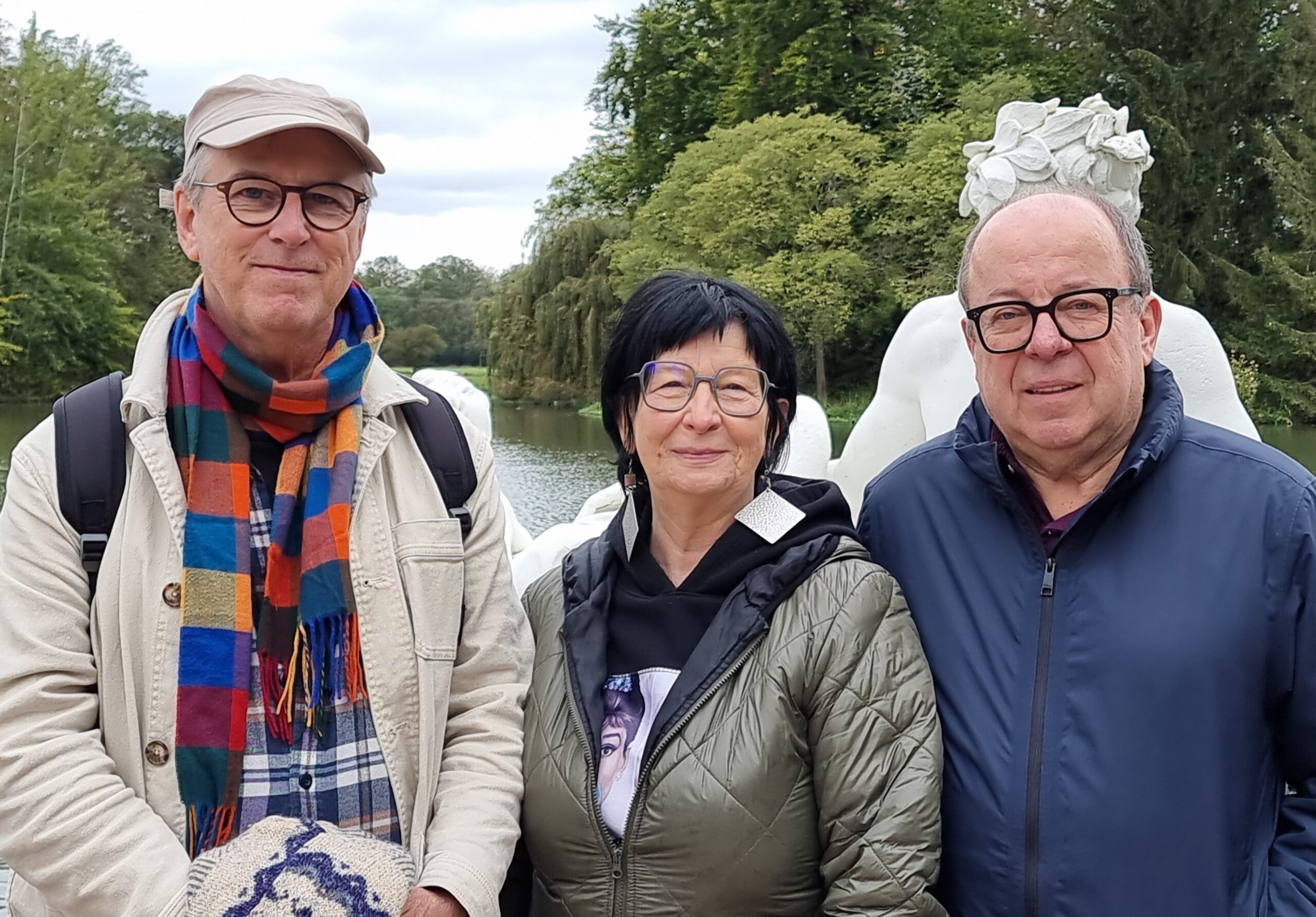
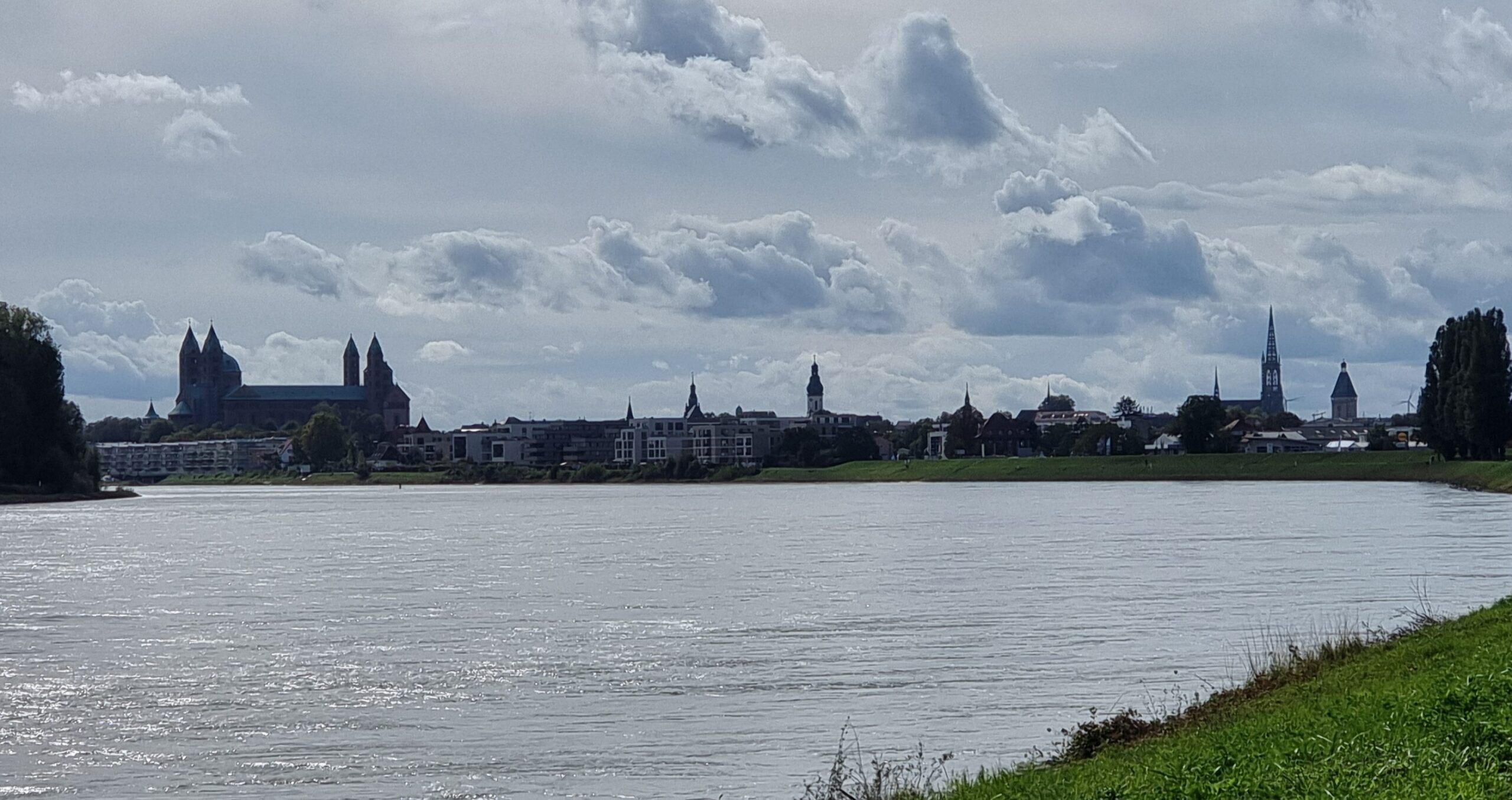
Keith Clouston, Marion & Matthias Nowack / Rhine, Speyer
Driving along beside the Rhine, we had our first glimpse of Speyer’s cathedral or Dom, visible on a long bend of the river and dominating the southern skyline. Ten minutes later Matthias parked the car and we were walking through cobbled streets lined with half-timbered houses towards the Dom, the pale green copper of its roofs contrasting with the pinkish red of its sandstone walls. Begun in 1030 and more or less completed by 1106, it is the largest remaining cathedral in Europe in the Romanesque style and a UNESCO World Heritage site.
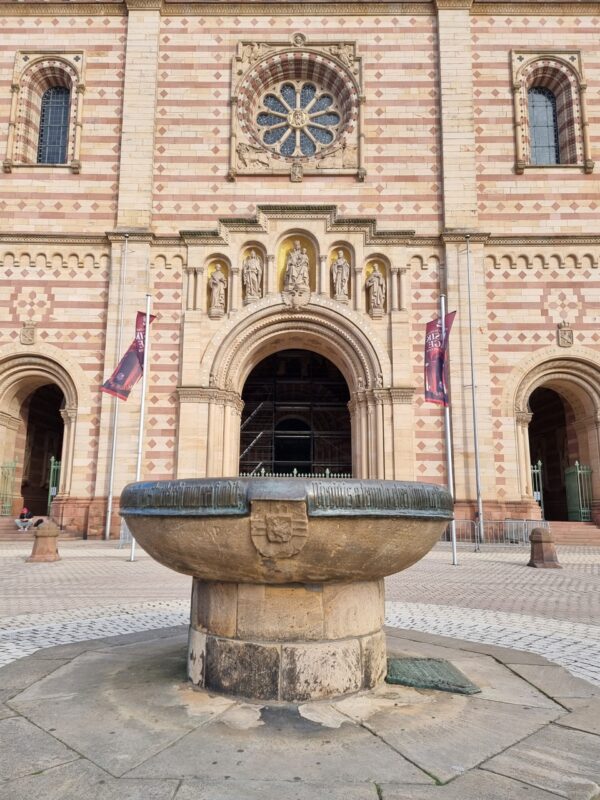
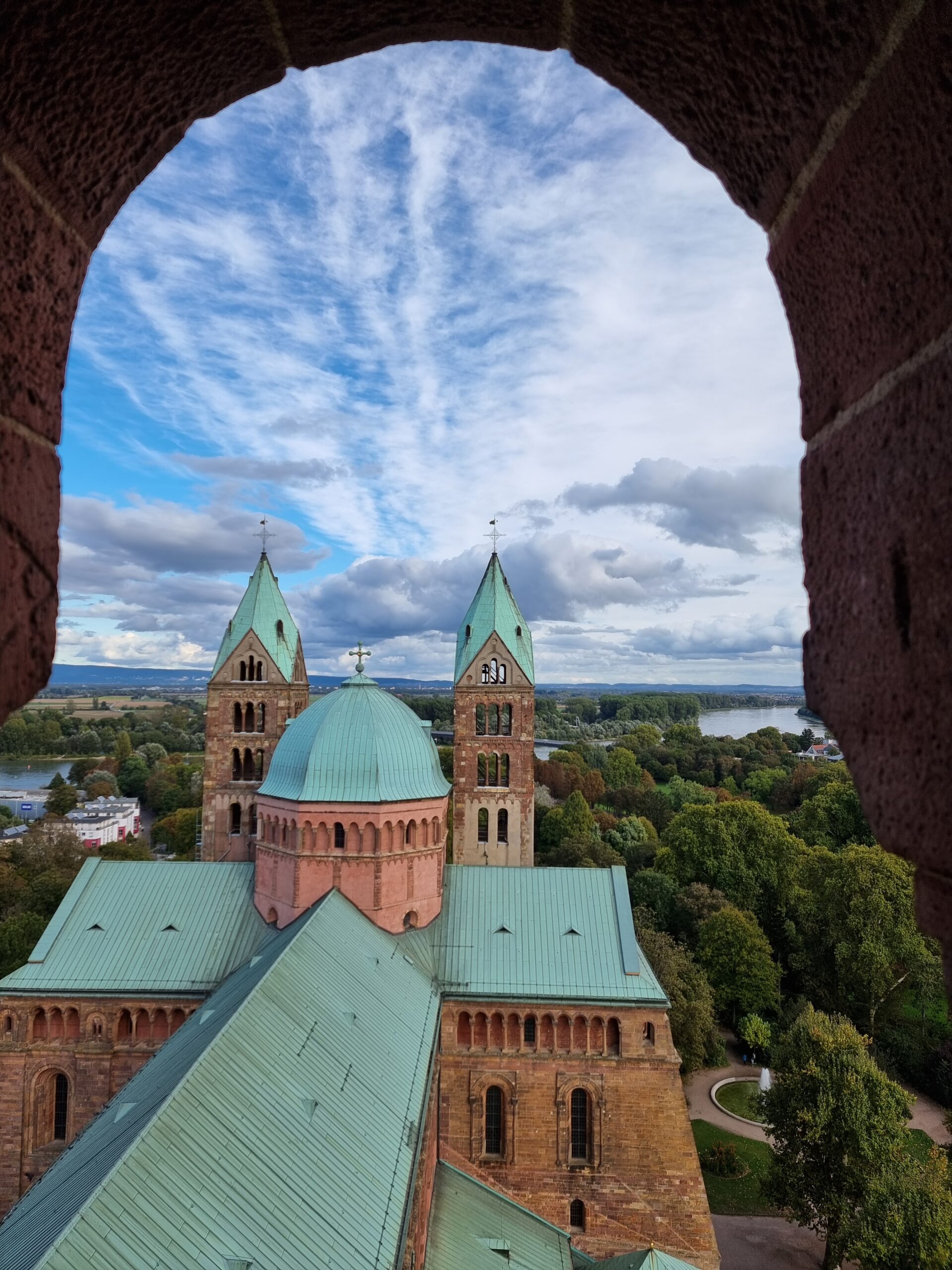
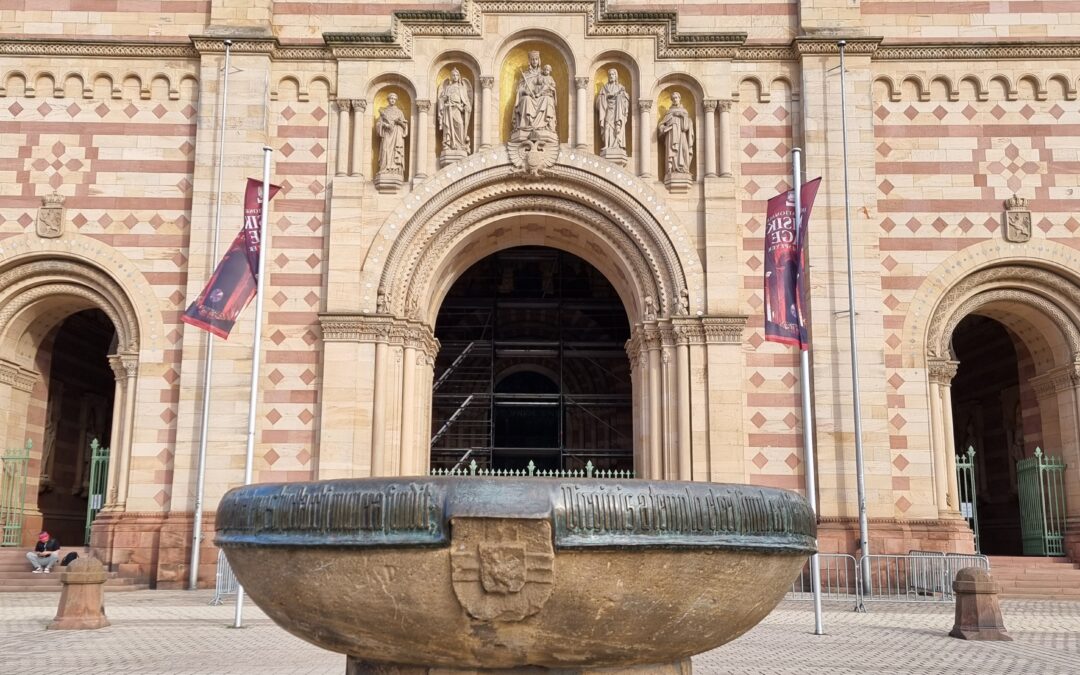
Domplatz, with wine ‘font’ / looking east from the south-west tower.
A few minutes later, and after a vertigo-inducing ascent up multiple flights of stairs open to the air, we found ourselves looking down on Speyer from the top of one of the Dom’s west towers, the mediaeval Altstadt or old town spread out two hundred feet below us like a multi-coloured picnic rug. On the western horizon we could just make out the dark green of the Pfälzerwald (Palatine Forest) and, beyond, the Vosges Mountains, on the far side of which is the border with France. Turning and facing the other direction we could see the Rhine just a few hundred yards away and in the far distance the eastern side of the Rhine valley and, towards the south, the hills of the Schwarzwald (Black Forest).
The Dom’s official title is the ‘Imperial Cathedral Basilica of the Assumption and Saint Stephen’, and according to the guide book, it is ‘the most important burial place of kings and emperors in Germany’, which probably puts it on a par with our own Westminster Abbey. So, once down from the tower, we descended to the enormous crypt where four crowned Holy Roman Emperors are entombed in huge stone sarcophagi alongside Empresses, kings, queens and bishops.
Helmut Kohl, the late German Bundeskanzler (Federal Chancellor) who presided over the reunification of Germany in 1990 – and, as well, a local lad from Ludwigshafen 20 minutes drive away – wanted to be buried here in this crypt.
Speyer’s Dom was for him ‘ein Stück Heimat’ (‘a little piece of home’) said Speyer’s former mayor Werner Schineller. But the cathedral authorities demurred, and when Kohl died in 2017, he was instead buried not far away on the edge of Adenauer Park: see below.
Outside on the Domplatz, the open space in front of the Dom’s West door. Matthias showed us what looked like a giant font: a great pedestalled sandstone bowl about five feet across, its interior surface lined with copper or zinc. Matthias explained, “On very special days, for example the inauguration of a new bishop, this is filled to the brim with wine and everybody just helps themselves.” He chuckled, “After a few hours not a drop is left.”
Next, we were off to the Judenhof, the Jewish so-called courtyard, just a short walk away. Here are the remains of one of the first synagogues north of the Alps. Established in the late 11th century, together with communities in Worms and Mainz, Jewish Speyer was the cradle of Ashkenazim culture in northern Europe (the three cities collectively known to the Jewish community worldwide as SchUM). NB Matthias used to be the SchUM coordinator for Speyer.
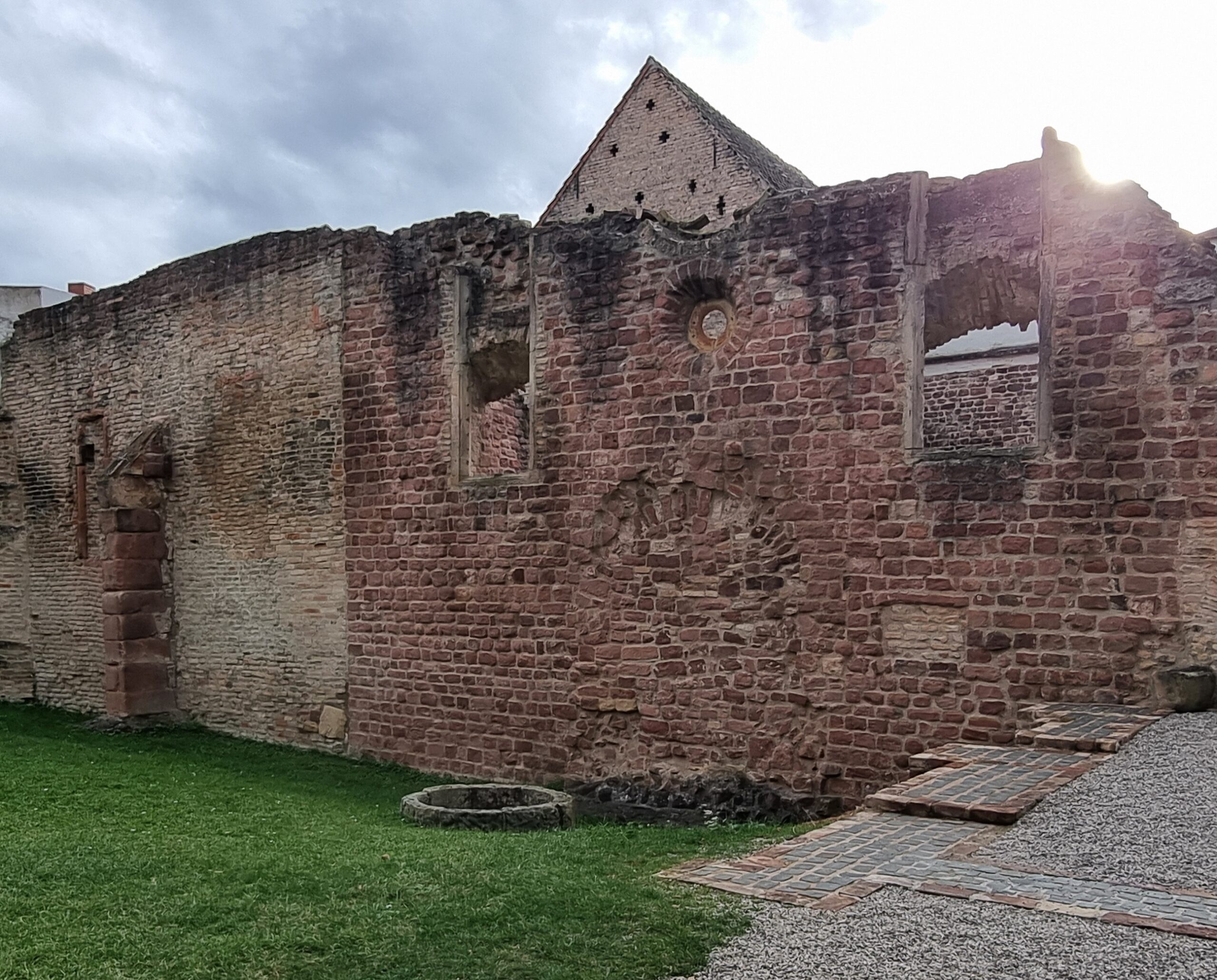
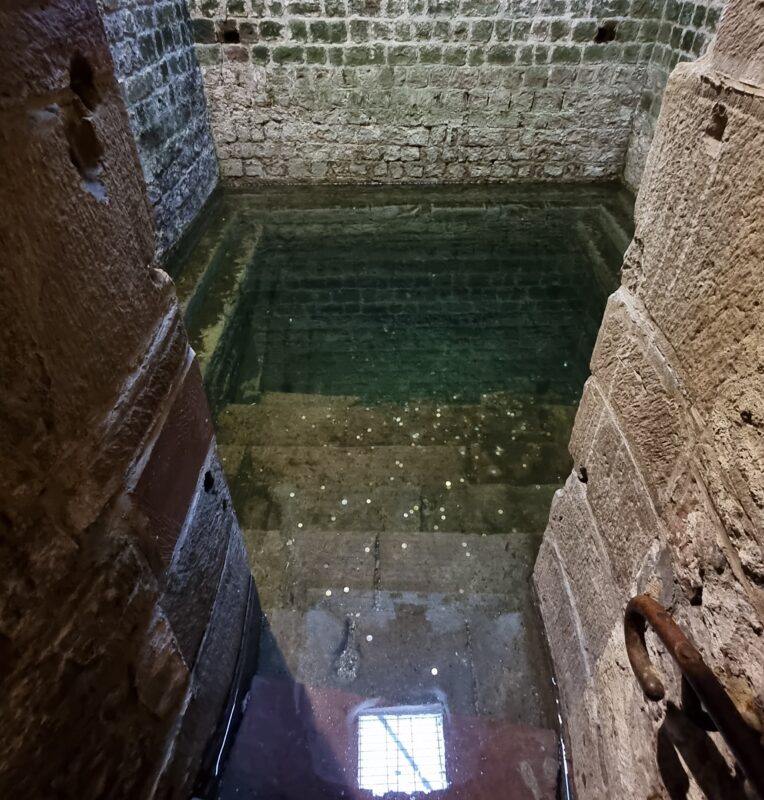
Judenhof: remaining walls / subterranean bath-house
The Judenhof is today a UNESCO World Heritage site, its focal point a magnificent ritual bath or mikvah. Reached by several flights of steep stone steps, these descend into the earth right down to the water table where the bath is fed by groundwater. The survival of such an important religious structure is due to the fact that by the mid 16th century the Jewish community had been expelled from the city, having suffered persecution and numerous pogroms. And although small Jewish communities re-established themselves in later years, they were restricted to other parts of Speyer. So, in the meantime, the original synagogue and its associated religious buildings fell into disuse and were reused or incorporated into Christian houses and thus effectively disappeared from public consciousness. Hence, the survival of the Mikvah during the Nazi period. Excavations took place in the 1960s leading to a refurbishment of the site in the 1990s and then its recognition by UNESCO in 2021. One interesting note for readers of a certain age: the Jewish surnames Spiro and Shapiro – as in 1960s pop singer Helen Shapiro – derive from the Hebrew word for Speyer: Schpira. And indeed the small museum attached to the site is called the SchPIRA Museum.
To end the day we went back to Matthias’s house in Otterstadt, a small village to the north of Speyer beside the Rhine, where Marion was waiting to greet us. Hugs all round followed by a delicious meal – Rindgulasch mit Knödel (beef goulash and dumplings). Then exhaustion finally overwhelmed us and Jude and I retired to bed.
The next day, with Marion at work – as accountant in a theatre in a town to the south of Speyer, Matthias drove us to the early 18th century Lutheran Dreifaltigkeitskirche (Trinity Church), where Christel was waiting to show us round. For those of us used to the visual austerity of many Protestant churches in Britain, especially in my case Scots Presbyterian ones, this is an extraordinarily exuberant and colourful space, a riot of painted wooden ceilings and balconies. A pulpit centrally placed on the south wall seemed like a recipe for pious neckache but by the simple expedient of double pews facing each other – like an old-fashioned train carriage – the congregants are able, as the sermon begins, to change places from sitting facing east and the altar to facing the preacher and the pulpit. We finished our tour with Christel showing us up to the church’s enormous Dachstuhl (roof structure) a fantastically intricate web of oak beams adding another three or four stories to the height of the church.
Then it was back in the car as Matthias drove us west to the eastern edge of the Pfälzerwald and the Hambacher Schloss (Hambach Castle), the so-called ‘cradle of German democracy’. Here, in 1832, the local people, who’d grown used to the new freedoms brought by the occupying forces of Revolutionary France in the period from 1798-1815, rallied in support of German democracy. They were protesting their desire for change in the face of repressive measures brought in by the succeeding Kingdom of Bavaria and demanded civil and political rights: liberty in a word. 1832 was also the first occasion that the colours black, red and gold were combined and used as the emblem of the democratic movement for a united Germany. These then became the colours of the flag of the German Empire, a short-lived democratic experiment from 1848-49. The same colours were revived by the Weimar Republic from 1921 to 1933 and then again post-World War Two: the colours of the German flag today.
As a footnote, the word Schloss is a German catch-all term used to describe a number of things which we in English usually have separate words for e.g.castle, palace, stately home, mansion, manor house. NB A castle in the English sense – a fortress with battlements and/or a moat – is often called a Burg.
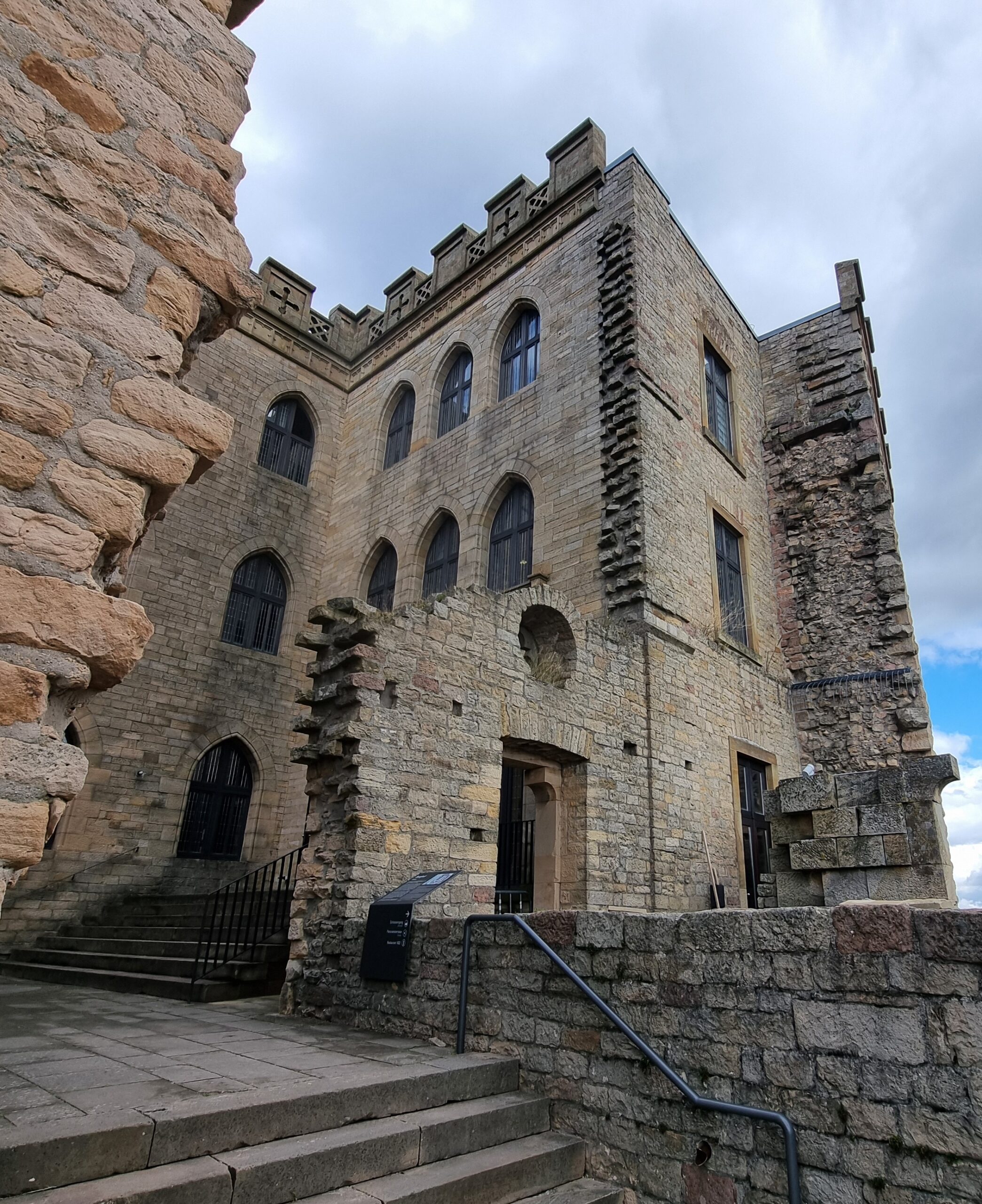
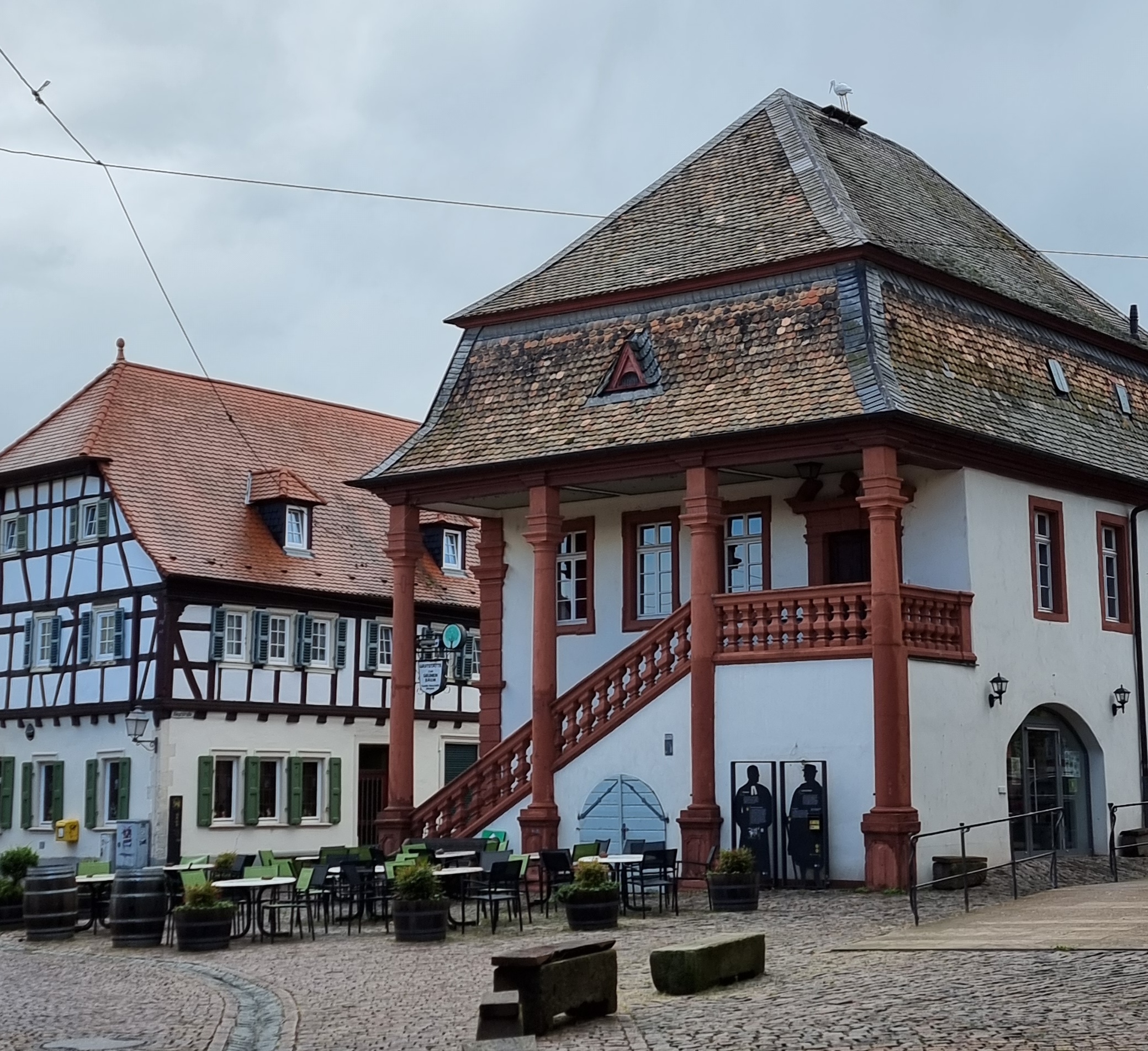
Hambacher Schloss / Freinsheim Rathaus
From the castle mound there are panoramic views across the Rhine Valley as far as Heidelberg to the north-east and the Schwarzwald to the south-east. Matthias pointed out the nearby Deutsche Weinstraße (German Wine Road or Route) which we’d crossed to get here. Running north to south along the edge of the Pfälzerwald, the Weinstraße is one of the warmest regions in Germany. Figs, lemons and Kiwi fruit thrive here but vines predominate, hence the name. By the way, at festivals here wine is often served in a Dubbeglas, a cross between a British straight pint glass and a dimpled jug or tankard, the indentations giving the drinker a more secure grip. After a couple of drinks you might find this helpful: a standard Dubbeglas holds half a litre of wine!
Next stop was Freinsheim, a picturesque village fortified in the 15th century and encircled by a thousand meter long defensive wall, with a massive town gateway and many original guard towers. Also known as the Palatine Rothenburg (referring to the Franconian town on the Romantische Straße tourist trail in Bavaria further to the east), it’s a maze of half-timbered houses with a late Gothic church and an 18th century Rathaus.
On the way back to Speyer, Matthias wanted to buy some wine from a local Weingut or vineyard. Depending on the time of year you may not need to make an appointment for a wine-tasting: just drive up and ask if you can taste some wine – with a view to buying of course. (But check individual Weingut websites first). So we arrived at the Weingut Benderhof in Kallstadt on the Weinstraße where a jolly, rather plump woman, who looked as if she’d just stepped out of an Albrecht Dürer engraving, produced an extensive tasting list. Jude and Matthias chose six whites and three reds. As I don’t drink wine, I looked on as the pair of them swirled wine around in their glasses, sniffing and snuffing loudly then sloshing the wine around in their mouths. A vase-shaped glass Spucknapf (literally spitbowl) had been provided though I didn’t see much being ‘spucked’. Approving noises followed and choices were made: Matthias came way with two cases of Riesling and Spätburgunder (the German name for Pinot Noir) and Jude a single bottle of 2022 Riesling Saumagen (which translates as Stuffed Pig’s Stomach… Yum).
Today, Thursday, with Matthias – and Marion too, taking a day off to be with us – we went east. “We’ve just crossed from the poor side of the Rhine to the rich side,” said Matthias as we drove over the bridge at Herrenteich a few miles north of Speyer, crossing from the Federal State of Rheinland-Pfalz into the State of Baden-Würtemberg. I wasn’t sure what Matthias meant by rich and poor at the time. But I’ve just looked up the 2023 GDP per capita figures for both States and they’re quite stark: Rheinland-Pfalz €41,797, Baden Würtemberg €54,339, almost a third higher. And indeed Rheinland-Pfalz as a mainly agricultural area is up against it with the industrial powerhouse that is Baden-Würtemberg. Big name companies such as Mercedes-Benz, Porsche, Bosch and Carl Zeiss are headquartered here. And as if to emphasise the disparity between the rich and poor sides of the Rhine, our first stop was Schloss Schwetzingen, a sumptuous-looking palace with a long salmon–pink façade dominating the little town of Schwetzingen.
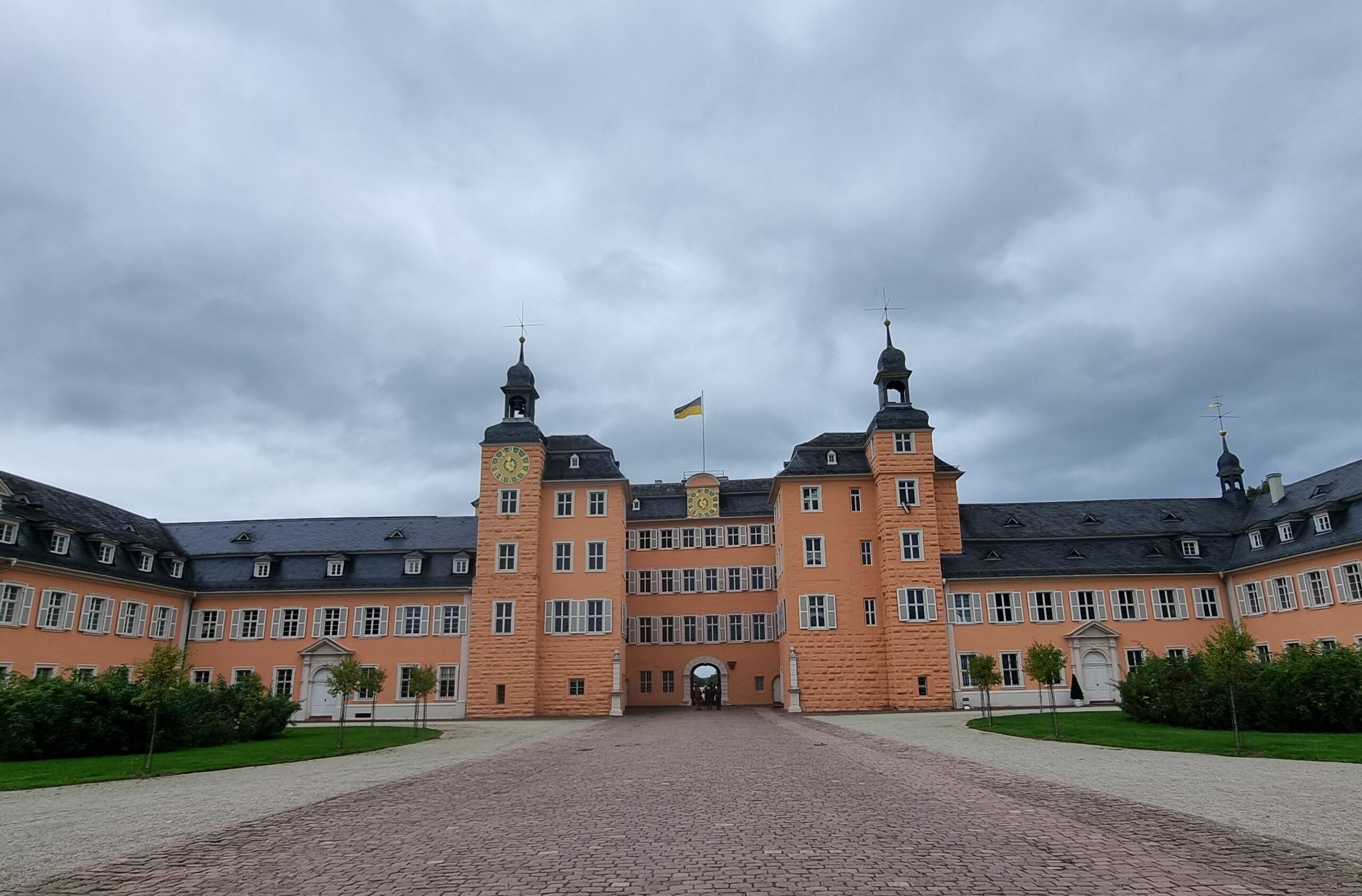
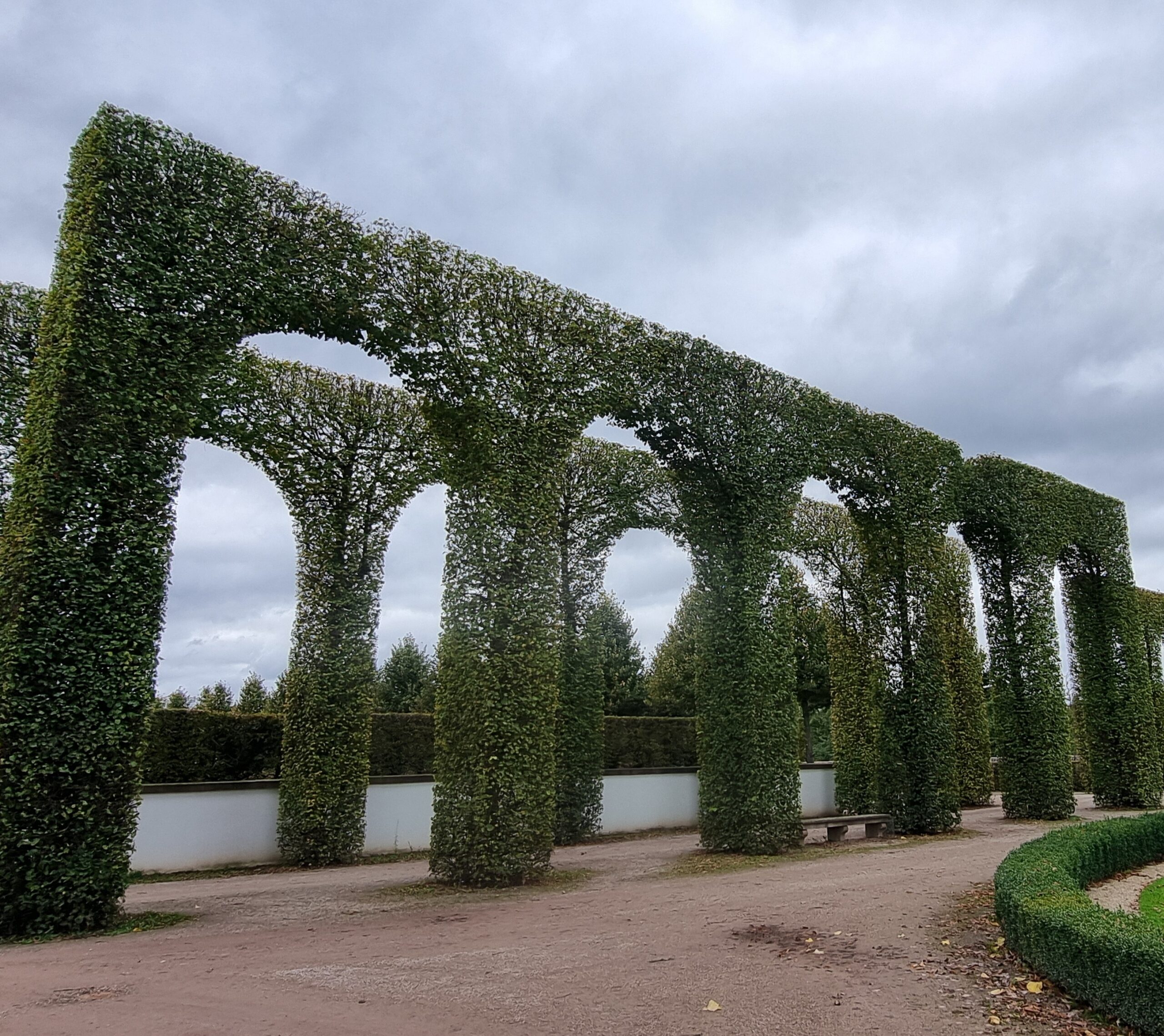
Schloss Schwetzingen
The Schloss was developed and used as a summer residence by Elector Charles IV (1742-99) who would move his court here from Mannheim during the warmer months. The extensive gardens are out of scale with the actual building itself which is relatively modest in scale despite its long frontage. It was intended to be much bigger, but lack of funds curtailed Charles’ ambitions. Still, the gardens are impressive with two different gardening styles in evidence: the French with its strict, geometric forms and the English with its more irregular, more ‘natural’ landscaped look. Within the grounds are represented a mixture of other periods/cultures: Classical Greece with a Temple of Minerva; the Islamic world with a ‘mosque’ (never actually used as such but popular as a photo backdrop for newly-weds from Germany’s Turkish community); and a Roman style Temple of Mercury.
By the way on the main pedestrian approach to the Schloss you can’t miss a large sculpture by Peter Lenk (1947- ) of a pig carrying on its back the Elector Charles accompanied by a scantily clad lady. Called the Glücksschwein (‘Lucky Pig’), the sculpture enshrines in stone the King of Prussia Fredrick the Great’s comment about Charles being a ‘lucky pig who has inherited more states than he has ever conquered.’
We returned to Speyer just in time for an afternoon concert in the Dom, part of an International Music Festival celebrating the bi-centennial anniversary of the birthday of composer Anton Bruckner (1824-96). Commencing with two pieces by Johannes Brahms, performed by a number of solo singers accompanied by the Rheinland-Pfalz State Orchestra together with a vast chorus comprising the combined voices of the cathedral choir and its youth choir. This was a truly impressive event, the quality of performance on a par with a concert at the Barbican.
We rounded off the day with dinner at Ulla’s, a flat near the Stadtzentrum. She introduced us to a German speciality: Fleischsalat, literally a meat ‘salad’ consisting of German sausage cut into long thin strips (like tagliatelle) with chopped gherkins, onions, mustard and mayonnaise. A hearty dish for a cold autumnal evening but not for the faint-hearted. Or vegetarians.
Friday and the last day of our visit. Mattias showed us Helmut Kohl’s rather forlorn-looking grave situated all on its own on the edge of Adenauer Park (named after post-war West Germany’s first Chancellor). Then we went down to a café on the Rhine where tourist cruisers we’d seen a week earlier in Boppard passed us, heading upstream. Then it was time to pack up our belongings and head back to Mannheim, taking the train to Strasbourg from where, after a couple more AirBnB nights, we eventually made it home to Chichester. Thanks to Matthias and Marion for their kind and generous hospitality and to Christel and Ulla. Bis zum nächsten Mal.
Afterword: When we were driving with Matthias to the Hambacher Schloss, I noticed signs to Reichsburg Trifels or Trifels Castle, a few kilometres to the south. The name sounded familiar somehow. I’ve since looked it up: Trifels Castle is where our own King Richard the Lionheart was held captive for ransom in 1193. It’s also, legend has it, the castle where the minstrel Blondel discovered Richard’s hitherto ‘secret’ location by singing the first verse of a song known only to both of them. Richard replied from his cell window with the second verse, thus revealing his whereabouts. In fact, historically, there was nothing secret about Richard’s location. But no ‘secret’, no legend. It’s a nice story, anyway. And I’d first read it in a Ladybird book, ‘Richard The Lion Heart’, when I was six or seven. I must make the effort to go to Trifels the next time I’m in Speyer.